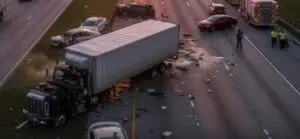


 In a serious Florida truck crash case, you may do everything right, get medical care, document the scene, report the claim, only to learn you’re dealing with a trucking company that doesn’t behave like a normal business defendant.
The name on the door isn’t the name on the insurance. The DOT number connects to a different entity. The carrier claims the driver was an “independent contractor.” Or the company quietly shuts down and reappears under a new name.
This is what people often mean when they talk about a “chameleon carrier.” And it’s one reason truck accident litigation is a different category of work than a standard auto claim.
What is a “reincarnated” or “affiliated” carrier under federal rules?
FMCSA regulations include a framework addressing reincarnated carriers. In 49 CFR Part 385 Subpart L, federal rules define reincarnated or affiliated motor carriers as carriers with common ownership, management, control, or familial relationship, and the subpart includes prohibitions and procedures related to those carriers.
Federal regulations also address operations out of service and record consolidation proceedings related to reincarnated carriers in 49 CFR 386.73.
That’s the federal government acknowledging a real-world problem: some carriers attempt to continue operations (or re-enter the industry) in ways that obscure their safety history or regulatory status.
FMCSA has also published a report to Congress discussing implementation of methods to identify chameleon carriers applying for operating authority.
Speak with a trusted Florida trial lawyer, contact Andrew Pickett Law now at (321) 503-4014.
Need free legal help in Florida?
We specialize in personal injury claims.

How does this “trap” show up in an injury claim?
Chameleon-style tactics can show up in several ways:
1) The “wrong defendant” problem
You sue the name you saw on the truck, only to be told:
- “That company doesn’t exist anymore,” or
- “That’s just a DBA,” or
- “That’s a leased vehicle under a different carrier,” or
- “The driver wasn’t operating under our authority.”
Delays benefit the defense. Meanwhile, evidence retention clocks keep running.
2) The “paper carrier” and layered contracting problem
Sometimes the carrier on paper isn’t the entity controlling operations day-to-day. There may be:
- A motor carrier
- A leasing entity
- A dispatch or management entity
- A broker or freight forwarder layer
FMCSA’s insurance filing requirements emphasize that entity names and addresses must match exactly across filings to avoid delays and complications in authority and registration.
That same identity precision matters in litigation.
Need free legal help in Florida?
We specialize in personal injury claims.

3) The “insurance mismatch” problem
Insurance may be filed under one entity while the truck branding suggests another. Without deep investigation, victims can end up negotiating with the wrong adjuster or missing a critical policy layer.
Why would a carrier do this?
Because bad safety history, unpaid claims, and regulatory enforcement have consequences.
GAO has discussed FMCSA vetting efforts designed in part to determine whether a new applicant may be a chameleon carrier.
If a carrier is trying to avoid a trail of violations, out-of-service orders, or prior lawsuits, changing names and numbers can create friction for investigators and attorneys who don’t know where to look.
Not sure where to start? Andrew Pickett Law is here to guide you. Call (321) 503-4014.
Red flags that suggest you may be dealing with a “chameleon carrier” scenario
- Multiple similar company names using the same address
- DOT numbers that changed recently without a clear business reason
- Carrier claims the truck was “leased on” to someone else
- Conflicting statements about who employed or controlled the driver
- Rapid dissolution or “inactive” corporate status after a serious crash
- Incomplete or evasive answers about insurance and authority
These aren’t proof by themselves. They’re indicators that you need deeper digging early.
How Andrew Pickett Law attacks the identity problem
A trial-ready trucking case typically includes:
1) FMCSA identity and authority research
FMCSA’s insurance filing framework ties operating authority to proof of insurance and ongoing maintenance of filings.
That matters when identifying which entity had operating authority at the time of the crash.
2) Corporate record comparison
Corporate filings, registered agents, officer lists, addresses, and related entities can reveal continuity even when names change.
3) Document-driven control analysis
The core question is control. Who controlled:
- Dispatch and route decisions?
- Safety policies?
- Maintenance?
- Driver training and qualification?
A carrier can call a driver an “independent contractor” all day. Documents often tell a more accurate story.
4) Litigation tools when necessary
When a carrier plays games, litigation tools like subpoenas and court orders become necessary to prevent a case from being stalled to death.
Federal rules specifically contemplate out-of-service and record consolidation proceedings addressing reincarnated carriers under 49 CFR 386.73, reflecting the seriousness of identity manipulation.
A local scenario: a truck crash near Viera that “doesn’t add up”
Imagine a collision near the Viera area, with transport trucks moving between I-95 exits.
You get the crash report, but the carrier listed doesn’t match the truck branding. The adjuster claims a different entity was responsible. Meanwhile, the carrier wants to move the truck back into service and close the claim quickly.
This is where the “chameleon carrier” problem stops being abstract. It becomes a direct threat to evidence and recovery.
Frequently Asked Questions
Is it illegal for a trucking company to change names?
A business can legitimately restructure, but when restructuring is used to evade safety compliance or accountability, federal rules and enforcement tools exist for reincarnated or affiliated carriers.
How do you prove continuity between companies?
Ownership, management, control, addresses, personnel, and operational records often show continuity, even when branding changes.
Why does this matter for compensation?
Because lawsuits and insurance claims must target the correct entities and policies. Getting it wrong causes delays, and delays often cost evidence.
You focus on recovery; we’ll focus on results. If you have been recently injured in a truck accident, Just Pickett. Call today for a free, no-obligation consultation.
Melbourne Office: 927 E New Haven Ave #201, Melbourne, FL 32901
Titusville Office: 605 S Palm Ave, Titusville, FL 32796
Phone: (321) 503-4014
Need free legal help in Florida?
We specialize in personal injury claims.