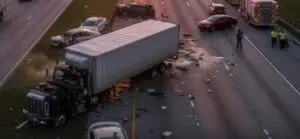


 If you’ve been hit by an 18‑wheeler, you’ll notice something almost immediately: the case feels bigger. More calls. More paperwork. More urgency. Sometimes it happens while you’re still trying to get your bearings, literally and medically.
Andrew Pickett Law sees a pattern in serious truck crash cases across Brevard County: insurers often move fast, not because they’re being helpful, but because they understand exposure. A commercial truck collision on I‑95 outside Melbourne or a wreck along US‑1 near Cocoa isn’t usually a “fender bender with a heavy vehicle.” It’s a high‑risk event that can produce catastrophic injuries, wrongful death, and long-term disability.
So why are 18‑wheeler settlements often higher? It’s not one magic factor. It’s the combination of damage, liability complexity, and insurance structure.
Are truck settlements always higher?
No. And anyone promising that is selling a storyline, not doing legal analysis.
But in many cases, truck claims do trend higher because:
- injuries are more severe
- future medical costs are larger
- more parties may be responsible
- there may be higher insurance limits available than in standard car cases
The word “may” matters. We don’t value cases on hype. We value them on proof.
Need free legal help in Florida?
We specialize in personal injury claims.

Why the injuries are often more expensive in truck crashes
The physics are unforgiving. An 18‑wheeler has mass, momentum, and stopping distance that passenger vehicles do not. When a crash happens, injuries tend to be more severe:
- traumatic brain injuries
- spinal cord injuries
- multiple fractures
- crush injuries
- internal injuries
- fatalities
Those injury categories are expensive in every sense: medical bills, lost wages, home assistance, and life disruption. When a person’s ability to work, drive, parent, or even sleep normally is affected, the claim value changes accordingly.
And in Brevard County, serious injuries often mean immediate transport and specialized care, sometimes through regional trauma pathways, followed by months of therapy, imaging, and specialist follow-ups.
Speak with a trusted Florida personal injury trial lawyer, contact Andrew Pickett Law now at (321) 503-4014.
Why insurance can be higher in trucking cases
Many trucking operations are subject to federal minimum financial responsibility requirements. Under 49 CFR § 387.9, minimum required coverage levels vary depending on the type of carrier and what’s being hauled, and in many standard “for-hire” property carrier situations, the minimum is commonly referenced at $750,000 (with higher requirements for certain hazardous materials).
That doesn’t guarantee a large settlement. But it can change what’s possible.
Contrast that with typical Florida personal auto claims, where policy limits can be modest and sometimes insufficient to cover serious injuries.
A practical point about trucking “paperwork”
FMCSA also recognizes filings like BMC‑91/BMC‑91X as proof of bodily injury and property damage insurance used for liability filings with the agency.
Those filings matter because identifying the correct carrier entity and coverage posture is part of building a collectible claim.
Need free legal help in Florida?
We specialize in personal injury claims.

Why the adjuster is calling you early
In many truck cases, the adjuster is calling early for one reason: they want the first version of the story.
Early calls often aim to:
- secure a recorded statement before you understand your injuries
- get you to minimize symptoms (“I’m sore, but fine”)
- push you into quick treatment decisions that later become “gaps”
- obtain broad authorizations that let them dig for unrelated medical history
- position comparative fault arguments early
You don’t have to be rude. But you do need to be careful. When the stakes are high, early “friendly conversations” become exhibits later.
What makes commercial liability more complex than it looks?
Truck crashes are rarely just “driver error.” Driver error may be part of it, but the deeper question is: why did the error happen, and who allowed it?
Common underlying causes include:
- fatigue and hours-of-service pressure
- unsafe scheduling and dispatch demands
- poor training or lack of supervision
- maintenance failures (brakes, tires, lights)
- overloaded or improperly secured cargo
- unsafe lane changes or speed decisions in congested corridors
And crucially, those issues often involve more than one legally responsible party.
Not sure where to start? Andrew Pickett Law is here to guide you. Call (321) 503-4014.
Why evidence moves the value needle in 18-wheeler cases
Serious truck cases are defended aggressively. The defense team often includes:
- insurance adjusters
- trucking defense counsel
- investigators
- sometimes reconstruction professionals
So the value of the claim isn’t only about injury. It’s also about what can be proven.
Electronic logging and record retention
For example, federal regulations require motor carriers to retain records of duty status and supporting documents for at least six months from the date of receipt.
That is not a “later” problem. That is a now problem.
If the case depends on fatigue, route timing, or compliance, records can be lost if no one moves quickly. Early legal action helps preserve what should be preserved.
How Florida fault rules can affect a truck settlement
Even in a truck case, fault allocation still matters. Florida’s comparative fault statute provides that in negligence actions to which the statute applies, a party found greater than 50% at fault for their own harm may not recover damages.
That legal reality shapes how trucking insurers negotiate:
- they look for ways to blame the passenger vehicle
- they emphasize lane changes, speed, or “cutting off” narratives
- they try to secure statements early that support those arguments
A truck settlement isn’t just a number. It’s a risk calculation based on evidence and fault.
What should you do if a trucking insurer is calling you?
Here’s a practical, reasonable approach:
- Get medical evaluation and follow-up care
- Document symptoms daily (headaches, dizziness, sleep, pain, limitations)
- Preserve photos, crash location details, and any witness contacts
- Avoid recorded statements until you understand the medical situation
- Do not sign broad releases without legal review
- Contact counsel early if injuries are serious or fault is disputed
The goal is simple: don’t let the claim be defined before your diagnosis is defined.
Why trial readiness matters in 18-wheeler cases
Trucking insurers settle fairly when they believe:
- the liability case is documented
- the injuries are well supported
- the plaintiff’s team can prove damages clearly
- the case can be tried effectively in local courts
Andrew Pickett Law emphasizes trial readiness and leadership by former prosecutor Andrew Pickett, whose professional background includes substantial courtroom experience developed in Brevard County.
That posture matters in negotiations. It changes what the defense thinks you’ll do if they refuse to act reasonably.
Frequently Asked Questions
Is $750,000 always the limit in truck cases?
No. Minimum requirements vary by operation and cargo type, and some carriers carry higher limits.
Should I talk to the trucking adjuster at all?
You may need to communicate basic information. But detailed recorded statements should be approached carefully, especially when injuries are ongoing.
What if the trucking company says I caused the crash?
That’s common. Evidence, reconstruction, and data preservation are how those disputes get resolved.
You focus on recovery; we’ll focus on results. If you have been recently injured in a truck accident, Just Pickett. Call today for a free, no-obligation consultation at (321) 503-4014.
Melbourne: 927 E New Haven Ave #201, Melbourne, FL 32901
Titusville: 605 S Palm Ave, Titusville, FL 32796
Need free legal help in Florida?
We specialize in personal injury claims.