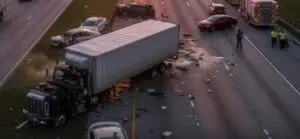

Andrew Pickett Law handles truck accident cases across Florida, and few crash types are more misunderstood than the so-called wide-turn squeeze crash. A large truck begins a turn, another road user is already present in the adjacent space or lane, and the truck’s movement closes that space until a car, motorcycle, bicycle, or pedestrian is trapped with nowhere to go. The defense often treats these cases as unfortunate geometry. In reality, they are usually about control, awareness, and preventable risk.
Large commercial vehicles do need extra room to turn. That much is true. The mistake is assuming that physical reality excuses whatever happens next. It does not. The law still expects the driver to manage the turn safely, signal appropriately, control the occupied space, and avoid taking a lane that is already being lawfully used by someone else.
These crashes can happen in city delivery zones, near industrial corridors, on port-adjacent routes, and at busy intersections feeding I-95, US-1, or State Road 528. In Brevard County, they may involve local delivery trucks, refuse vehicles, utility trucks, buses, or tractor-trailers moving through tight urban geometry. The smaller vehicle or rider is often blamed for being “in the blind spot,” but that is not the end of the legal analysis.
If a truck’s wide turn crushed your space and the carrier is already hinting that you should have “known better,” Andrew Pickett Law can push the case back where it belongs: on evidence and safety rules.
Why do wide-turn squeeze crashes happen?
Sometimes the answer is straightforward. The truck driver swings left to create room for a right turn, and a motorist or rider interprets that move as an invitation to proceed on the right. Seconds later, the trailer or truck body sweeps back and closes the lane. In other cases, the truck simply starts turning from an improper position or without accounting for traffic already beside it.
FMCSA safety guidance warns motorists not to squeeze around large vehicles making wide turns, and that guidance matters. But the presence of a safety warning does not immunize the truck driver or the company. The driver still has to use mirrors, signals, lane discipline, and ordinary care. If the truck takes space that was already occupied, the liability inquiry becomes much more specific than “you were beside a truck.”
A commercial vehicle can create this danger through late signaling, poor mirror checks, distracted driving, fatigue, bad route planning, inadequate training, or simple impatience. Those are all discoverable issues in a truck accident claim.
What does Florida law expect during a turn?
Florida turning rules require drivers making right turns to do so as close as practicable to the right-hand curb or edge of the roadway, with some additional considerations when overtaking or turning near bicyclists. That does not mean a truck can never swing left to set up a turn. It does mean the turn has to be executed safely and with control over surrounding traffic conditions.
This distinction is important. Defense lawyers sometimes present “wide turns require space” as though it resolves the case. It does not. The real questions are whether the signal was timely, whether the truck encroached into an occupied lane, whether the driver verified the right side was clear, and whether the company trained the driver on the maneuver for that exact type of intersection.
Truck cases are not won by general statements about blind spots. They are won by identifying what this driver knew, what this company required, and what the data shows happened in the seconds before impact.
What evidence should be preserved right away?
Wide-turn crashes are corporate evidence cases. The scene matters, but the file behind the driver matters too.
Critical evidence often includes:
- onboard video from the truck and any side-facing cameras
- electronic logging device and telematics data
- GPS route history and speed information
- driver qualification files and prior safety history
- company training materials on urban turns and vulnerable road users
- dispatch communications and delivery pressure
- mirror, camera, and sensor equipment on the vehicle
- maintenance records affecting steering, brakes, or visibility
- photos showing lane markings, curb radius, and point of contact
A truck company may move quickly after a serious crash. That is one reason people with catastrophic injuries, wrongful death claims, motorcycle accident claims, and bicycle accident claims should not wait to involve counsel. The carrier already understands the evidence race.
Can the smaller vehicle or rider still share fault?
Yes, sometimes. A motorist who ignores an obvious turn signal and drives into a clearly closing space may face real comparative-fault arguments. So might a cyclist who attempts to pass on the right in a way that the scene shows was plainly unsafe. Good representation does not require pretending otherwise.
But comparative fault is not a defense shortcut. The carrier still has to explain the driver’s actual conduct. Did the truck begin the turn from too far left? Was the signal late? Was the smaller vehicle already established in the lane? Did the truck continue despite seeing, or having every reason to see, the other road user? That is where many defense theories weaken.
Why are these cases often more serious than they first appear?
Because squeeze crashes create crushing, under-ride, and secondary-impact mechanisms. A rider may be forced into the curb, a car may be pinned and spun, or a bicyclist may be knocked into another travel lane. The medical consequences can be devastating: orthopedic reconstruction, brain trauma, spinal injuries, internal injuries, and permanent disability. The insurance fight that follows is rarely proportionate to the harm unless the case is prepared thoroughly.
Frequently asked questions about wide-turn truck crashes
Does a truck’s need for extra turning space excuse a collision?
No. The driver still has to manage the turn safely and avoid taking occupied space.
Can the trucking company be liable too?
Yes. In many cases the company’s training, supervision, route pressure, policies, or vehicle equipment become part of the claim.
Call Andrew Pickett Law today to schedule your free consultation. If a truck, bus, or commercial vehicle crushed your lane during a turn, Andrew Pickett Law is ready to build the liability case from the ground up.
Need free legal help in Florida?
We specialize in personal injury claims.