



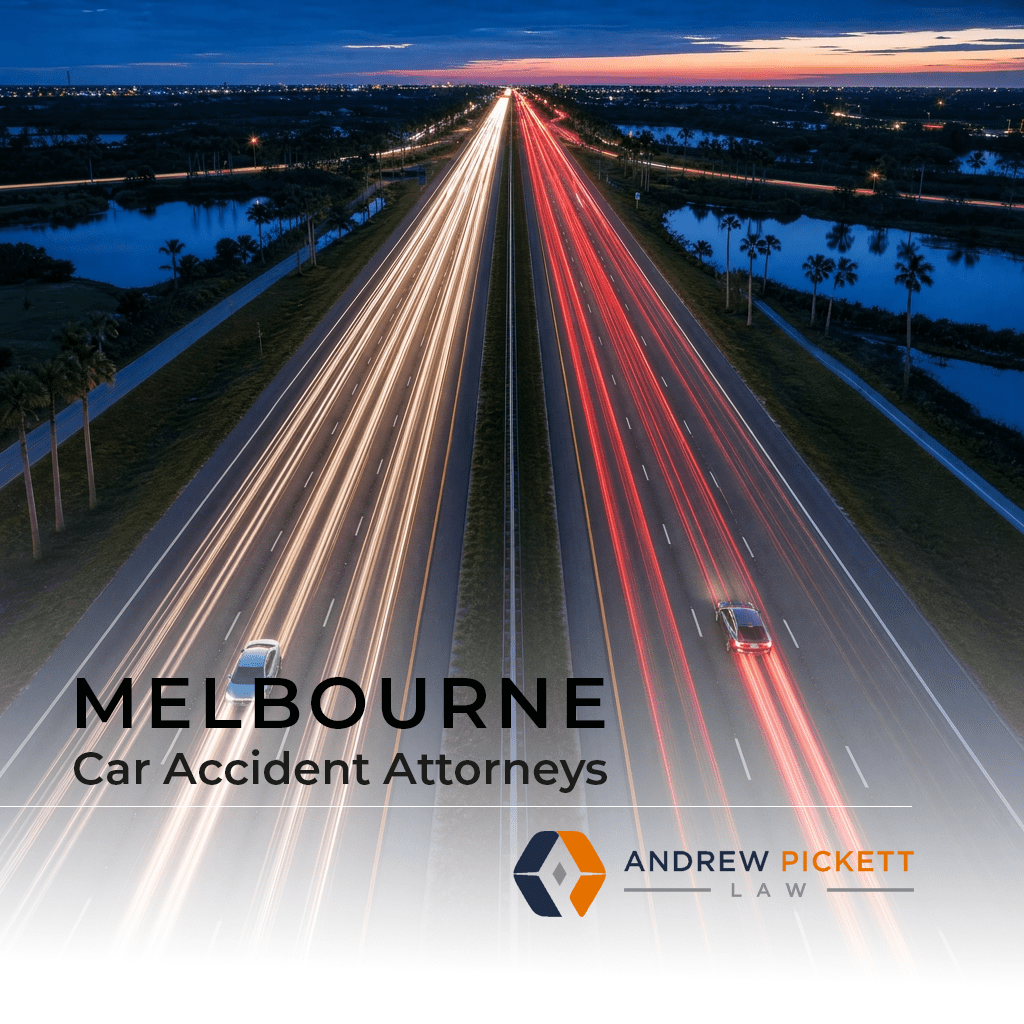
Andrew Pickett Law is a top Melbourne car accident law firm that handles injury cases throughout Melbourne and Brevard County for victims who need help getting medical treatment and financial recovery. Andrew Pickett prosecuted cases in the Eighteenth Circuit, the same circuit where a Melbourne car case is tried, and he takes injury cases to a jury.
What You Need To Know
- A car claim has more moving parts than it looks like from the outside. You and the insurance company settle most of the moving parts in the first two weeks. Your own insurer can require a statement under oath early on, and refusing can cost you the coverage you’re paying for.
- Plenty of car claims settle fine without a lawyer. People lose other car claims in the first month because they didn’t know a deadline existed. We’d rather you finish here knowing which kind you have, whether or not you ever call us.
- See a doctor within 14 days of the crash. Miss the 14-day deadline and the medical coverage on your own policy won’t pay anything at all.
- Your own insurer pays 80 percent of your medical bills and 60 percent of lost wages, up to $10,000. The $10,000 ceiling drops to $2,500 only if a provider decides you didn’t have an emergency medical condition.
- The damage to your car and the damage to you are two separate claims. Read the release before you sign for the car, because the other side can argue a broadly worded release covers both claims.
- Order your crash report yourself. A copy costs $10 plus a $2 fee from the state portal. You can get yours straight away, even though the public can’t for 60 days.
- The insurer puts a value on your file before anyone knows how your injury ends. Raising the number later takes proof gathered on purpose, and gathering it is most of the work.
Start with the two claims hiding inside one crash, because signing the wrong paper for the car can close the injury claim. Whether you need a lawyer, what your own insurer can demand, and the fee come next. The coverage rules, the deadlines and the statute citations sit further down.
The Two Claims Inside Your One Crash
The damage to your car and the damage to you are two separate claims, and the insurer settles the car first because the car is easy. A check for the car can arrive within days.
Read the release before you sign for the car. The other side can argue that a broadly worded release covers both claims, and an insurer that gets your signature on a broad release has closed your injury claim for the price of a fender.
Sign for the car only on a release that names the car and nothing else. If the paper mentions bodily injury, personal injury or all claims, put the paper down and ask for a narrower release.
See a doctor within 14 days of the crash whether or not the car claim has settled. Miss the 14-day deadline and the medical coverage on your own policy won’t pay anything at all.
You Can Find Out in a Half-Hour Call Whether You Need a Lawyer
Plenty of car claims settle fine without a lawyer. You saw a doctor inside 14 days, your own policy paid the first bills, you healed, and the other driver’s insurer paid the remaining bills without arguing. Take the money and keep every dollar.
People lose other car claims in the first month because they didn’t know a deadline existed. Nobody sends a letter saying the 14-day window closed, and nobody warns you the car release reached your injury claim.
The insurer puts a value on your file before anyone knows how your injury ends. Raising the number later takes proof gathered on purpose, and gathering it is most of a lawyer’s work on a car case.
We’d rather you finish here knowing which kind of claim you have, whether or not you ever call us. Call, describe the crash, and we’ll tell you in half an hour. The review costs nothing and nobody signs anything.
What Your Own Insurer Can Demand From You
Your own insurer can require a statement under oath early in the claim, and refusing can cost you the coverage you’re paying for. Lawyers call it an examination under oath, and the policy you signed agreed to it.
Give the statement, and give it with your records in front of you. Your own company is interviewing you on the record, and the other driver’s insurer will eventually read your answers.
The other driver’s insurer has no such right. You don’t owe an adjuster from the other company a recorded statement, and you can decline on the phone without giving a reason.
Order your crash report yourself as well. A copy costs $10 plus a $2 fee from the state portal, and you can get yours straight away even though the public can’t for 60 days.
Hiring a Car Accident Lawyer in Melbourne Costs Nothing Until Your Case Pays
Andrew Pickett Law works on a contingency fee only. We take a minority percentage of whatever we recover for you, and we charge no fee at all if we recover nothing. You’ll never write us a check to get started, and you’ll never see an hourly bill.
Florida law caps the percentage a law firm can charge, so no firm sets its own ceiling. We back the Bar’s cap with a commitment of our own. We work your case to its maximum value, and we spend money building that value long before a settlement arrives. We pay the filing fees, we order the medical records, and we hire the experts, and no bill reaches you while you’re still healing.
Ask any firm you talk to, including us, who pays the advanced costs if you lose. Firms answer the question differently, so get the answer in writing before you sign anything.
Andrew Prosecuted in the Court Your Melbourne Case Goes To
Andrew Pickett grew up in Brevard County and spent years as a prosecutor in the Eighteenth Judicial Circuit before he represented injured people. Brevard judges try Melbourne car cases in the Eighteenth Judicial Circuit. He trained at the Trial Lawyers College, and he takes injury cases to verdict. An insurance company prices a file differently when the lawyer across from it has taken cases to a jury.
You’ll deal with the lawyer on your case rather than a call center. Clients tell us the same thing in their reviews: they always knew what was happening in their own case. We’ll tell you the next step and roughly when it comes, and when something changes, we’ll call you about the change.
Read Us What the Insurers Sent and We’ll Tell You Where You Stand
A first call is a conversation, not a commitment. You describe the crash and what the insurers have sent you so far, and we’ll tell you whether the car release reached your injury claim and what your own policy still owes.
Bring the crash report number if you have it, and any release or check the insurer has sent. You can call with no paperwork at all.
If Andrew Pickett Law takes your case, our fee comes out of a recovery and nothing comes out of your pocket while the case runs. If the claim doesn’t need a lawyer, we’ll tell you and you can take the offer.
Car Accident Lawyers Serving Melbourne
Car accidents are among the most common causes of serious injuries throughout Melbourne and the surrounding Brevard County area. Heavy traffic along major roadways such as US-1, Wickham Road, Eau Gallie Boulevard, Babcock Street, and Palm Bay Road frequently contributes to collisions involving passenger vehicles, commercial trucks, motorcycles, and rideshare vehicles.
At Andrew Pickett Law, our legal team represents individuals who have been injured in a wide range of vehicle crash scenarios, including rear-end collisions, distracted driving crashes, intersection accidents, and multi-vehicle collisions. Our firm investigates the circumstances of each accident and works to hold negligent drivers and insurance companies accountable for the harm they cause.
Compensation Available After a Car Crash
Depending on the circumstances of your accident, injured victims may be entitled to compensation for a variety of financial and personal losses. Our Melbourne injury attorneys help clients pursue compensation for:
- Medical bills and ongoing medical treatment
- Lost wages and reduced earning capacity
- Vehicle damage and related property losses
- Pain and suffering
- Long-term disability or catastrophic injuries
- Wrongful death damages for families who have lost loved ones
Because insurance companies often attempt to minimize payouts, having an experienced attorney can make a significant difference when pursuing compensation after a serious accident.
What No-Fault Insurance Covers, and What It Does Not
Florida is a no-fault state. According to Florida Statute 627.733, owners of vehicles registered in Florida must carry personal injury protection (PIP), and Florida Statute 324.022 requires them to carry property damage liability (PDL) coverage as well.
If you’re in an accident, your policy pays for your medical expenses and other damages. It’s important to know the statute of limitations and local traffic regulations and their impact on these cases.
How Long You Have to File a Car Accident Claim
Car accident cases have a specific statute of limitations. According to Florida Statute 95.11, you have two years to file a claim for damages.
Local Traffic Regulations and Their Impact on Accident Cases
According to Florida Statute 316.065, accidents causing injuries or death or property damage amounting $500 or more must call 911 at the scene. All local regulations require reporting such incidents to the police so a report can be made and an investigation can be done.
Navigating the Claim-Filing Process
After a car accident, you must file a claim through your car insurance company. Doing this as soon as possible is best. If you’re injured, you must see a doctor for treatment within 14 days of the accident.
Frequently Asked Questions About Car Accident Claims
What should I do after a car accident in Melbourne?
After a crash, you should seek medical attention, report the accident to local law enforcement, and document the scene if it is safe to do so. It is also important to avoid discussing fault with insurance companies before speaking with a lawyer. An experienced Melbourne car accident attorney can help protect your rights and handle communications with insurance companies while you focus on recovery.
Car accident claims in Melbourne: four things people get wrong
Do I have to prove I am permanently injured?
Almost every page on this subject tells you that Florida makes you prove a permanent injury before you can claim. True, and it is only half of the sentence. The permanent-injury requirement applies to compensation for pain, suffering and loss of enjoyment of life. It does not apply to your money.1
Medical bills beyond what no-fault paid, the wages you lost, the earning capacity you may not get back, the cost of care you still need — those are claimable against an at-fault driver whether or not you ever prove permanency. People are talked out of perfectly good claims by being told they “don’t meet the threshold,” when what they actually have is a claim for everything except the pain.
When someone tells you that you do not have a claim, find out which half they mean.
Why did my $10,000 of no-fault coverage stop at $2,500?
Everyone knows Florida no-fault carries $10,000. Far fewer know that you only get the full amount if a qualifying practitioner records that you had an emergency medical condition. Without that finding, the ceiling drops to $2,500.2
Not a reduction. A quarter of what you were counting on, and one emergency room visit will pass it.
The determination has to come from the right kind of provider — a medical doctor, an osteopathic physician, a dentist, a physician assistant or an advanced practice registered nurse.2 A chiropractor is not on that list. Someone treating only with a chiropractor, however good the treatment, may never get the finding made, and may not discover it until the benefits stop at $2,500.
So the practical instruction is short: see a doctor inside the first fourteen days, make sure a qualifying provider examines you, and ask whether an emergency medical condition has been documented. It is one question and it is worth $7,500.
Can settling the damage to my car end my injury claim?
The damage to your vehicle and the damage to you are two separate claims, usually handled by two separate people at the same insurer, and the vehicle one usually moves much faster.
Read what you are signing when the property damage is settled. A release drawn broadly enough can be argued to cover more than the car. Settle the vehicle, take the check, and check that the document says so in terms — particularly when the offer arrives quickly and the injury is still being investigated.
The same caution applies before you accept anything from the at-fault driver’s insurer while your own uninsured motorist coverage may still be in play. There is a notice step there that can void your own coverage if it is skipped.
What is a smaller injury claim actually worth?
Firms are reluctant to do this sum in public. Here it is.
Say you were hit at a junction, went to the emergency room, had eight weeks of physiotherapy, missed three weeks of work, and recovered fully. Bills of around $9,000, lost wages of $2,400. No permanent injury.
- No-fault pays 80 percent of the medical bills and 60 percent of the lost wages, up to the combined $10,0003 — so roughly $7,200 of the bills and $1,440 of the wages, or $8,640 in all. The cap is not reached, so about $1,360 of the coverage is still there if treatment continues.
- That leaves about $1,800 in bills and $960 in wages unpaid. Both are claimable against the at-fault driver.
- Pain and suffering is not claimable, because there was no permanent injury.
- So the realistic recovery is in the low thousands — before a contingency fee and case costs come out of it.
On numbers like these, a lawyer may not improve your position, and we will say so. A claim of this shape is often better handled by you, directly, with an itemised demand and copies of the bills. Where it changes is if the injury turns out not to be temporary, if the other driver was uninsured, if liability is disputed, or if the insurer starts behaving unreasonably. Those are the calls to make.
And if the honest answer is that your claim is small, that is not a reason to leave it. It is a reason to spend an afternoon on it rather than two years.
How soon do I have to see a doctor?
Within 14 days of the accident. If you do not get initial treatment inside that window, your no-fault medical coverage pays nothing at all — not a reduced amount, nothing.4
This is the single most common way people lose coverage they were entitled to. It happens to those who feel bruised rather than injured, and to those who are hurt badly enough that getting to a follow-up appointment is difficult in itself. Count the days from the accident and get seen.
How much does no-fault coverage actually pay?
Less than the headline suggests, and that “$10,000” figure carries a lot of weight.
It pays 80 percent of your medical bills and 60 percent of lost earnings, and the $10,000 is a combined ceiling for both — not $10,000 of medical treatment.5 The remaining 20 percent of the bills is still yours.
And the ceiling is only $10,000 if a doctor documents that you had an emergency medical condition. Without that finding it drops to $2,500.6 So ask at your first appointment whether the provider will record that determination, and keep the paperwork. It is a four-times difference and it costs you nothing to ask.
Everything beyond that — surgery, rehabilitation, longer-term lost earnings, and pain and suffering where you qualify — comes from a claim against the driver who caused it. What you can claim there follows different rules.
What if I don’t have health insurance?
You will still be treated, and you have more options than you probably think. This is one of the most common reasons people delay getting care after an accident, and delaying is the one thing that reliably makes both the injury and the claim worse.
An emergency room has to treat you. Federal law requires hospital emergency departments to examine and stabilise anyone who arrives, regardless of insurance or ability to pay.7 An emergency room cannot turn you away at the door because you are unable to pay.
If a vehicle was involved, no-fault coverage does not care whether you have health insurance. It pays either way — and it may not be your own policy that pays. Work out whose coverage applies to you before assuming there is none.
Ask the hospital about financial assistance. Non-profit hospitals are required to have a written financial assistance policy, and many people who qualify never ask because they assume it is only for the destitute.8 Ask for it by name, in the billing office, and ask for the application. Ask as well whether you qualify for Medicaid, which can sometimes cover treatment you have already received.
Some doctors will treat you now and be paid later. This is done through a letter of protection — a written promise that the doctor will be paid out of your settlement rather than by you at the time. It is a normal arrangement and it makes treatment possible for people who would otherwise go without.
But it is not free, and you should understand the trade before you agree to it. A provider treating on a letter of protection generally bills at full rates rather than the discounted rate an insurer would have negotiated, and every dollar of it comes out of your settlement at the end. It reduces what reaches you.
So the honest advice runs against our own convenience: if you have any way to run treatment through health insurance, no-fault coverage, or a hospital financial assistance programme, use it first. Keep the letter of protection for treatment you cannot get any other way. We would rather you keep more of the settlement than have a tidier file.
Should I talk to the insurance companies?
It depends entirely on which insurer is calling, and “never talk to insurers” is bad advice that can cost you your coverage.
Your own no-fault insurer can require your cooperation. It can ask you to give a statement under oath and to be examined by a doctor it chooses, and if you refuse or simply do not turn up it can stop paying your medical bills.9 These are obligations under a policy you bought.
The other driver’s insurer is in a different position. A recorded statement to them is voluntary. You are not required to give one, and there is rarely a reason to give one early.
So the useful question when the phone rings is not whether to talk, but whose policy they are calling about. Ask that first.
Didn’t the state get rid of no-fault insurance?
No. A bill to repeal it passed the Legislature in 2021 and was vetoed by the Governor that June.10 Similar bills have been filed since without passing. The state’s no-fault system is still in force, and everything above still applies.
The rumour persists because the repeal came close, and a lot of articles written at the time were never updated.
I don’t own a car. Whose no-fault coverage pays for me?
There is an order to it, and you work down the list.11
- Own a vehicle registered in this state? Your own policy pays — even if you were walking or cycling at the time.
- No vehicle, but you live with a relative who has one? Their policy pays.
- Neither? The policy on the vehicle that struck you pays.
This is why a pedestrian or a cyclist struck by a car is usually inside the no-fault system without ever having thought of themselves as being in it. It is also why the answer for a visitor from out of state, or someone whose household has no car at all, is different from the answer for their neighbor.
One exception catches people out: if a motorcycle struck you, none of this applies. Motorcycles are not required to carry this coverage at all.12
What if the driver who hit me has no insurance?
This happens more often than people assume, because state law does not require drivers to carry any coverage for injuries they cause. The law requires no-fault medical coverage for the driver themselves, and property damage cover for your car. Cover for your injuries is optional.13
So a driver can be entirely at fault, fully licensed, fully legal — and have nothing available to pay for your surgery. In a great many serious cases the money does not come from the person who caused it. It comes from your own policy, through uninsured and underinsured motorist coverage.14
Which makes the most useful thing you can do tonight very simple: find your policy’s declarations page and look for uninsured motorist coverage. It tells you whether you have it, how much, and whether it is “stacked” — which multiplies it across the vehicles on your policy.
I wasn’t in my own car. Does my coverage still help?
Usually yes. Uninsured motorist coverage follows the person, not the vehicle. The policy on the car sitting in your driveway can cover you while you are a passenger in someone else’s car, riding a bicycle, or walking across a car park.
People routinely do not claim on coverage they are paying for, because it did not occur to them that a policy on a car they were nowhere near could apply. It often does.
Can I accept the other driver’s offer and then claim on my own policy?
Not without telling your own insurer first, and this one is unforgiving. Before you settle with the at-fault driver’s insurer, your uninsured motorist carrier has to be notified and given the chance to respond.15 Signing a release without doing that can end the claim against your own policy altogether.
It is a trap precisely because the first offer often looks like good news. A quick check from the other side, taken at the wrong moment, can cost far more than it pays.
How do I get a copy of the accident report?
Accident reports here are sealed to the public for 60 days — but that restriction does not apply to you. The people involved, their attorneys and their insurers can get a copy immediately.16
Reports come from the state’s online report portal for $10 plus a $2 service fee. Allow about ten days after the accident for yours to appear, and download it within 48 hours of buying it or you pay again. You will be asked to sign a short sworn statement first, confirming you will not use the report to solicit business — that is a condition of getting it, and misusing the information in it is a felony.17
What if no police officer came to the scene?
Then filing the report is your job, and there is a deadline on it. Where an accident caused property damage but did not require an officer, the driver has to file a written report within 10 days.18 The form is HSMV 90011S, and you can email it to the state or post it to Tallahassee.
This matters more than it sounds. Without it there may be no official record connecting the other driver to the accident at all — which becomes their word against yours when you make a claim months later.
An officer files instead of you when there was a death, an injury or any complaint of pain, a DUI or a driver leaving the scene, a vehicle that had to be towed, or a commercial vehicle involved.19
Which police agency has my report?
It depends on exactly where you were hit, and it decides who you buy the report from.
- Inside Melbourne city limits — Melbourne Police Department
- Unincorporated Brevard County — Brevard County Sheriff’s Office
- US-1, US-192 and I-95 — usually the Florida Highway Patrol
If you are not sure which side of a city line you were on, the responding officer’s agency is printed on the information slip you were handed at the scene.
Why do I have to prove a permanent injury?
It is the trade-off built into the state’s no-fault system. You get medical coverage regardless of who caused it; in exchange, the right to claim for pain and suffering is limited to more serious injuries. If a court decides you cannot show evidence of one, that part of your claim is dismissed.20
Practically, this is why the wording in your medical records matters so much. A doctor recording a permanent injury is often the single most valuable line in the file.
It also does not always apply. The rule turns on who hit you, not on your own insurance. It does not apply if the driver who hit you was uninsured, if a taxi was involved, or if you were struck by a motorcycle.21 It does apply to commercial trucks. If someone has told you flatly that you must prove permanency, find out which of these you are in.
References
- Fla. Stat. § 627.737(2) — the permanent-injury threshold applies to damages for pain, suffering, mental anguish and inconvenience; economic damages are not subject to it
- Fla. Stat. § 627.736(1)(a)3.–4. — personal injury protection limited to $2,500 unless a physician licensed under chapter 458 or 459, a dentist licensed under chapter 466, a physician assistant or an advanced practice registered nurse has determined that the claimant had an emergency medical condition
- Fla. Stat. § 627.736(1)(a)–(b) — 80 percent of reasonable medical expenses and 60 percent of lost income, subject to a combined $10,000 limit
- Fla. Stat. § 627.736(1)(a) — initial services within 14 days
- Fla. Stat. § 627.736(1)(a), (1)(b) — 80 percent of medical expenses, 60 percent of lost income, $10,000 combined
- Fla. Stat. § 627.736(1)(a)4 — $2,500 limit absent an emergency medical condition determination
- 42 U.S.C. § 1395dd (EMTALA) — emergency medical screening and stabilisation regardless of ability to pay
- 26 U.S.C. § 501(r)(4) — written financial assistance policy required of tax-exempt hospitals
- Fla. Stat. § 627.736(6)(b), (7) — examination under oath and medical examination; consequences of non-compliance
- SB 54 (2021) — PIP repeal passed and vetoed 30 June 2021
- Fla. Stat. § 627.736(4)(e) — order of priority for personal injury protection benefits
- Fla. Stat. § 627.732(3) — “motor vehicle” defined as four or more wheels
- Fla. Stat. §§ 627.733(1), 324.022 — personal injury protection and property damage liability required; bodily injury liability not required for ordinary private passenger vehicles
- Fla. Stat. § 627.727 — uninsured and underinsured motorist coverage
- Fla. Stat. § 627.727(6) — notice to the uninsured motorist insurer before settling with the liability carrier
- Fla. Stat. § 316.066(2)(a)–(b) — 60-day confidentiality, and immediate access for parties, their attorneys and insurers
- Fla. Stat. § 316.066(2)(d), (3)(d) — sworn statement as a condition of access; misuse a third-degree felony
- Fla. Stat. § 316.066(1)(e) — driver self-report within 10 days where no law enforcement report is required
- Fla. Stat. § 316.066(1)(a) — when a law enforcement officer must file the report
- Fla. Stat. § 627.737(2)–(3) — permanent-injury threshold for non-economic damages, and dismissal where it is not met
- Fla. Stat. §§ 627.732(3), 627.733(1)(b), 627.733(4) — four-wheel definition; taxicab exemption; loss of immunity where the owner carried no required security
Other Case Types We Handle
In addition to representing victims of car crashes, Andrew Pickett Law handles a wide range of accident and injury cases throughout Melbourne and Brevard County, including:
- Truck Accident
- Motorcycle Accident
- Uber & Lyft Accident
- Pedestrian Accident
- Bicycle Accident
- Slip and Fall
- Dog Bite Injury
- Boating Accident
- Wrongful Death
Areas and Zip Codes Served From Our Melbourne Office
- 32901 – Downtown Melbourne / Crane Creek
- 32904 – West Melbourne
- 32934 – Wickham Park / North Melbourne
- 32935 – Eau Gallie / Croton Road Corridor
Free Case Evaluation
Please describe what happened. We will review your case for free and work to secure the highest legal compensation possible.
5000+ Cases Reviewed
Sebastian Martinez
$200,000 Verdict
"Our family is flat out impressed with the Andrew Pickett Law firm technical mastery, they never wavered with kind direction as our recovery prolonged during the COVID-19, and they delivered the maximum settlement possible."
how the claim process works
Step 2
We take action
Our dedicated team gets to work investigating your claim.
Step 3
We fight for you
If we take on the case, our team fights to get you the maximum compensation legally possible.
Free Case Evaluation
Please describe what happened. We will review your case for free and work to secure the highest legal compensation possible.
5000+ Cases Reviewed
Beatrice Maxime
$1,000,000 Verdict
"I am so very grateful to have had this firm represent me. I was in a car accident a few years ago, but the car insurance company of the person who totaled my car would not replace my car, nor pay for my medical bills. We ended up going to court and because of Mr. Pickett, we won the case. Thank you so much for all you did for us!!!!"
Meet Andrew Pickett

Dealing with the murky policies of insurance companies designed to confuse and prevent you from receiving compensation is our expertise.
15+ years experience as a personal injury attorney.
Specialized in battling insurance companies.
95% settlement rate for clients.
Handled 500+ personal injury cases.
Collected more than $38 million for clients.
500+ people have chosen Andrew as their attorney.
520+ Satisfied Clients
Our latest reviews on Google

Jennifer Cleveland
1 month ago
Lauren and her team are the best! Thank you for all the help, I 10/10 recommended them!

Ivanova Rodriguez
1 month ago
Great experience, kindness people

andrew rafidi
1 month ago
Project Backpack was a major success! Wonderful community outreach event! Emma Vinson is incredibly kind and helpful!

michele stanevich
2 months ago
What a wonderful event. Very well organized. He introduced himself to everyone. I will keep him in mind if and when I need a lawyer.

Lisa & Andrew Arnabat
2 months ago
Our team (attorney Tiffany Whitehouse, paralegals Vonda and Lindsey, our legal assistant Lauren, and Caroline) at Andrew Pickett Law has been absolutely amazing. They have been communicative from start to finish and have gone above and beyond in all aspects. They treated us like people, not like another number. Thank you for all of your help & guidance throughout what would have been an otherwise overwhelming and confusing process.

Thomas Preston
2 months ago
Andrew Pickett law for is a real good law and I will recommend him to need a real good lawyer.Thank you very much from my case.My name is Thomas Preston.Thank you

Close Family
3 months ago
Andrew Pickett and his team were very professional and supportave throughout my whole case. They took care of all the bills and successfully negotiated with the insurance companies. They were able to get 850,000 towards all the medical bills. I would definitelly recommend them.

Orestes Olmo
3 months ago
(Translated by Google) Excellent service. I was recommended by my daughter-in-law, and the beginning has been wonderful. They asked all the necessary questions and were incredibly quick at the start of the process. I am very grateful for their attention. (Original) Excelente trato ,fui recomendado por mi nuera y la verdad el inicio a sido maravilloso, hicieron las preguntas necesarias y una rapidez increíble en el comienzo del proceso , les agradezco mucho esta atención

Caitlin Cheatham
3 months ago
Amazing experience, they got me the best settlement I could’ve asked for. Always responded quickly and kept me in the loop! Highly recommend

Heidi Bushing
3 months ago
The team at Andrew Pickett is amazing. They helped me with two accidents and have been very attentive and communicative.

pebbs jai
3 months ago
I highly recommend this law office. Special thank you to Allison W. for answering all my questions and concerns. All staff were very helpful, professional and pleasant. They also give back to the community so if you are looking for a well knowledgeable law firm this is it!! Mr Andrew Pickett I appreciate you.

Krissy Green
3 months ago
Thank you all for your support I appreciate so much you guys are awesome

Stephanie Mortier
4 months ago
I absolutely love this law firm , down to the absolute best communication, and the follow up calls with details . Thank you guys !

Kimmy Ware-Simmons
4 months ago
A special thanks to this wonderful team! I’ve been truly blessed to be represented by Andrew Pickett Law. All my questions have been attentively addressed and explained perfectly in a way I am fully able to understand. This Lawfirm treats everyone with respect and like family. 10/10 review and definitely recommend!
Stephanie Mortier
4 months ago
Thank you , she was very helpful and friendly .

Steve Ryland
4 months ago
Andrew and his team provided outstanding legal representation with a high level of professionalism, responsiveness, and attention to detail. He communicated clearly throughout the process and delivered a result we were very satisfied with. I truly appreciate his expertise and would highly recommend him to anyone in need of strong, reliable legal counsel.

christian leon
4 months ago
Working with Tiffany Whitehouse, Vonda, and Lauren at Andrew Pickett Law Firm was an amazing experience for me. They were really professional, attentive, and committed to my case from beginning to end. Their diligence and genuine concern for achieving the greatest result for me were what truly stood out. I genuinely felt like I was in good hands the entire time because of their dedication and teamwork, which made a difficult situation much easier to face. I got the best outcomes I could have imagined because of their hard work and knowledge. I am incredibly appreciative and would heartily suggest their team to anyone in need of legal assistance.

Erin Mclachlan
4 months ago
My experience is based on 2 settlements so far, still pending another case and 1 of the already settled cases M&M took but didn't want to keep after stringing me along for 4 months. So just choose Andrew Pickett Law, don't waste time with another injury attorney. Tiffany Whitehouse is great, she was confident in my cases, kept me informed and very accommodating. We didn't even have to go to court for those 2 cases. And because I had already trusted them with 2 cases, I also gave them a third case which settled quickly. My only regret, I just wish I had known about them sooner. Thanks for everything! I have already recommended my friends and clients and will continue.

Carlos Mangual
4 months ago
Tiffany Whitehouse has been a tremendous help to me through out my whole process majorly because of her communication she’s always one phone call or text away and really gives me comfort to have any of my questions or worries answered so quickly

Hannah Dorris
4 months ago
If I could give more than 5 stars I would. I cannot say enough amazing things about Tiffany Whitehouse and her entire team. From the very beginning, I felt genuinely cared for, supported, and prioritized throughout my entire experience. Tiffany is an absolute powerhouse her knowledge, confidence, and attention to detail truly set her apart from any attorney I’ve ever worked with. She knows her craft inside and out, and you can feel that level of expertise in every interaction. What really stood out to me was how responsive and efficient everyone was. Communication was always clear and timely, and I was never left wondering about the status of my case. Tiffany and her paralegal, Vonda, worked seamlessly together and made everything feel organized and stress-free. Vonda was incredibly kind, attentive, and always made sure I had what I needed. They both went above and beyond in ways that made a stressful situation feel manageable. I also want to recognize the admin team, especially Lauren and Hailey. They were so welcoming, helpful, and professional every time I interacted with them. It’s clear that this entire office operates with a high level of care, compassion, and dedication to their clients. Another thing that truly stood out to me was how thorough and patient everyone was when answering my questions. No matter how many I had, they took the time to explain everything in detail and made sure I fully understood even if it took 20 minutes. That level of patience and dedication meant so much and made me feel confident every step of the way. What meant the most to me is that they didn’t treat me like just another case they truly cared about me as a person. They checked in regularly, made sure I felt supported, and consistently went the extra mile. That kind of genuine compassion is rare to find. If you’re looking for a legal team that is not only highly skilled but also truly invested in you, I wholeheartedly recommend Andrew Pickett Law. They exceeded all of my expectations and I am beyond grateful for everything they’ve done for me. Thank you all SO incredibly much!