



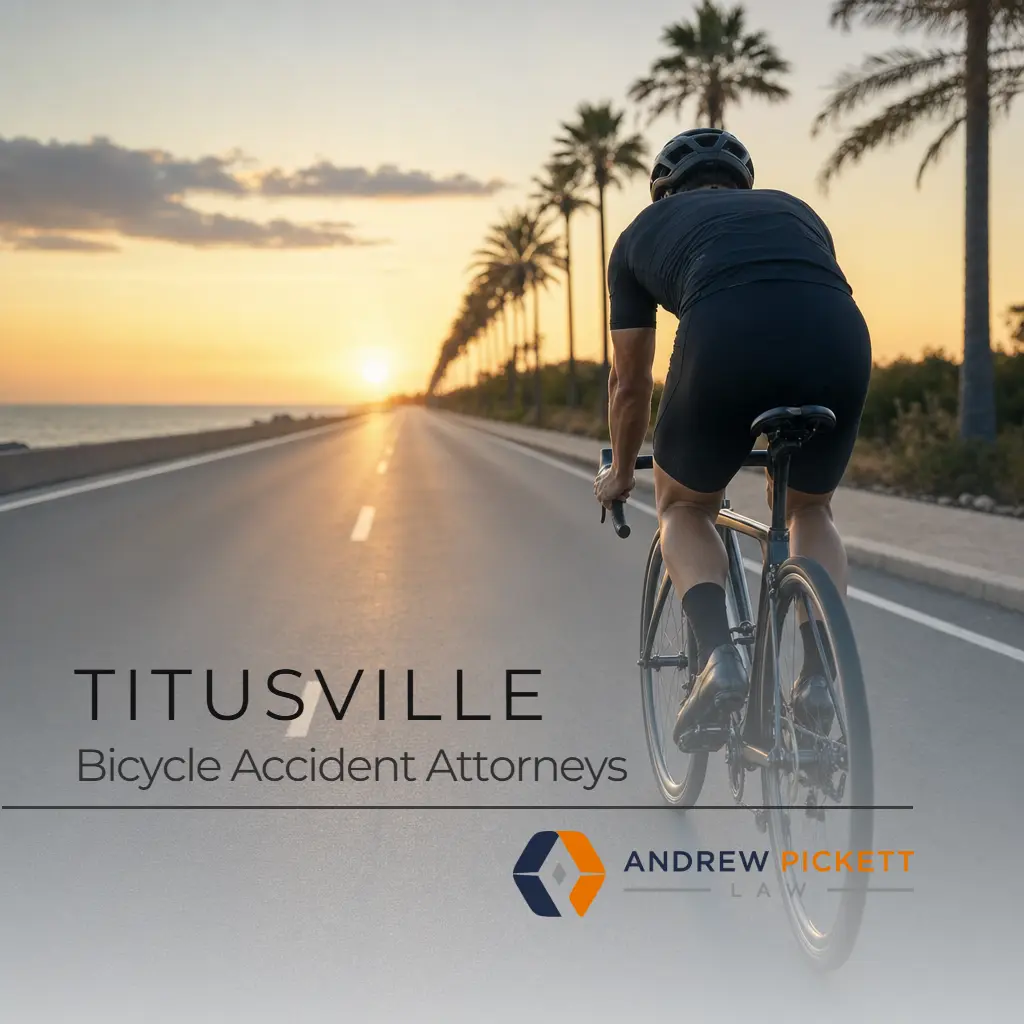
Andrew Pickett Law is a top Titusville bicycle accident law firm that handles crash cases throughout Titusville and North Brevard County for victims who need help getting medical treatment and financial recovery. Clients say in their reviews that they always knew where their case stood, which matters while an insurer argues whether a cyclist is covered.
What You Need To Know
- A bicycle claim has more moving parts than it looks like from the road, and the first few weeks decide most of those parts. A lawyer who handles bicycle claims every day keeps the moving parts from being decided against you.
- Use anything here, with us or without us.
- An insurer may tell you a cyclist doesn’t have coverage for medical bills. The statute says otherwise, because a bicycle has no motor of its own.
- See a doctor within 14 days of the crash, whether you own a car or not. Miss the 14-day deadline and you lose Florida’s first layer of insurance money for good.
- You’ve got two years to file a lawsuit, not the four years many websites still say.
- Riding in the traffic lane is often legal, because the keep-right rule for cyclists carries written exceptions.
- A school zone camera may hold video of your crash, and the city erases that video 90 days after the ticket is finished.
- Andrew Pickett prosecuted cases in the same courthouse system where your case would be tried, and he takes cases to a jury.
- The crash report. A report is ready about ten days after the crash. Only you, your lawyer and your insurer can get a copy for the first 60 days.
- School zone camera video. The city destroys the video within 90 days after the ticket from that day is finally resolved.
- State road records. US 1 and SR 50 belong to FDOT, which releases project and signal records to anyone who asks in writing.
- Your bike and your gear. Within weeks you’ll fix the bike or throw it out, and the damage pattern goes with it.
If a driver hit you while you were riding here, an insurer has probably already started arguing. A letter or a phone call told you there may be no coverage, because you were not in a car. Somebody asked why you were not riding in the bike lane. The first medical bills came addressed to you, as though the question of who pays them were already settled.
Start with whether you need anybody at all. The coverage denial, the lane rules and the first offer come next. The deadlines, the records and the statute citations sit further down.
Riders Who Heal Fast and Get a Fair Offer Don’t Need Us
Plenty of riders settle a bicycle claim without anybody’s help. A driver admits fault, your own car insurance pays the first bills, you heal in a few weeks, and the driver’s insurer pays the remaining bills without an argument. Take the offer and keep every dollar.
Two sentences change a simple claim into a fight. An insurer tells you a cyclist has no coverage for medical bills, or an insurer starts asking why you weren’t in the bike lane. Either sentence is an argument, not a rule.
You don’t have to work out which one you’re facing on your own. Call us, describe the crash, and we’ll tell you what the statute says and whether the insurer is reading it correctly.
The call and the review cost nothing, and nobody signs anything to have the conversation. Even if you settle the claim yourself a week later, you settle it knowing what the law owes you.
The Insurer Already Told You Something That Isn’t True
A letter or a phone call may have told you there’s no coverage for your medical bills, because you weren’t in a car. The statute says otherwise.
Florida’s no-fault coverage follows the person rather than the vehicle. A bicycle has no motor of its own, so the exclusion that catches a motorcycle rider doesn’t reach a cyclist. If you own a car, your own policy pays the first medical bills after a driver hits you on a bike.
See a doctor within 14 days of the crash whether you own a car or not. Miss day 14 and you lose the first layer of insurance money for good.
You can treat a denial in writing as an opening rather than an ending. Ask the insurer which statute it relies on, and ask in writing.
Why You Weren’t Wrong to Be in the Traffic Lane
Somebody has probably already asked why you weren’t in the bike lane. An insurer asks the question to move a percentage of the blame onto you.
Florida’s keep-right rule for cyclists carries written exceptions, and riding in the traffic lane is often exactly what the law expects. A lane too narrow to share, a hazard at the edge, a parked car or a right turn ahead all put a rider legally in the lane.
Nobody can tell you an e-bike broke a Titusville rule either, because Titusville has no e-bike rule to break.
Florida divides blame rather than switching it. You keep a live claim with a share of the fault, and only a share above half ends it.
A Bicycle Accident Lawyer’s Fee Is a Share of Your Recovery
Andrew Pickett Law works on a contingency fee only. Our fee is a share of whatever we recover for you, and we charge no fee at all if we recover nothing. Nothing changes hands to get started, and you’ll never see an hourly bill.
Florida law caps a contingency share on a sliding scale, so no firm here sets its own ceiling. The exact percentages, and how case costs are advanced and repaid, are laid out on the Titusville page. We back the Bar’s cap with a commitment of our own. We work your case to its maximum value, and we spend money on the case long before a settlement arrives. We pay the filing fees, we order the medical records, and we hire the experts, and no bill reaches you while you heal.
Ask any firm you talk to, including us, who pays the advanced costs if you lose. Firms answer the question differently, so get the answer in writing before you sign anything.
Andrew Has Ridden the Same North Brevard Roads Since 1987
Andrew Pickett has lived in Brevard County since 1987 and graduated from Satellite High School. He’s ridden and driven the roads in North Brevard for decades. He spent years prosecuting cases in the Eighteenth Judicial Circuit, and Brevard judges try Titusville injury cases in the Eighteenth Judicial Circuit. He trained at the Gerry Spence Trial Lawyers College in 2018, and he takes injury cases through jury verdict rather than settling every file.
Our clients keep returning to the same subject in their reviews. Each client knew what was happening while the case was happening. We’ll tell you the next step and roughly when it comes. If something changes, you’ll hear about the change from us.
Read Us the Insurer’s Letter and We’ll Tell You If It’s Right
A first call is a conversation, not a commitment. You describe the crash and what the insurer has told you so far, and we’ll tell you whether the coverage answer you got was right.
Bring the crash report number if you have it, and the name of your own car insurer if you own a car. You can call with no paperwork at all.
If Andrew Pickett Law takes your case, our fee comes out of a recovery and nothing comes out of your pocket while the case runs. If the claim doesn’t need a lawyer, we’ll tell you and you can take the offer.
Two Deadlines Can End Your Bicycle Claim
Two clocks started the moment the driver hit you. Neither one pauses while you heal, and neither one pauses while an insurance company argues about your coverage.
See a doctor within 14 days
Florida’s first layer of insurance money reaches only riders who got medical care within 14 days of the crash.1 Missing that window does not reduce the money. It erases it. A hospital visit on the day of the crash counts, and so does urgent care or your own family doctor. That deadline applies whether you own a car or not.
File a lawsuit within two years
You have two years from a Titusville bicycle crash to file a lawsuit.2 The deadline used to be four years. Lawmakers cut it in 2023, and a lot of published material still shows the old number. Anyone planning around four years is planning around two years that no longer exist.
A claim about the road itself runs on an added step. Suppose a signal was dark, or a lane design funneled you into traffic. Before you can sue a government agency over the road, you must send that agency a formal written notice and give it time to answer. The law calls that step a pre-suit notice.3 The notice period runs inside your two years, not on top of them.
take action / Step 3 We fight for you. Same block used on /melbourne/ and /titusville/.]
Who Pays Your Medical Bills When a Driver Hits You on Your Bike
The bills come addressed to you, and the envelope makes it look like a settled question. Nobody has settled who pays them, and most riders guess wrong about it.
Car insurance pays your first medical bills after a bicycle crash. In most cases the policy that pays is your own auto policy, even though your car never left the driveway. Florida attaches this first layer of coverage to insurance policies rather than to vehicles, and that is why people call it a no-fault state. The coverage doing the work is called personal injury protection, or PIP, and it pays no matter who caused the crash.1
A bicycle qualifies you for that coverage because of what moves it. PIP reaches anyone struck by a motor vehicle while not occupying a self-propelled vehicle.4 A bicycle runs on muscle rather than on a motor, so a struck cyclist is not occupying a self-propelled vehicle and is inside the benefit on the statute’s own words. Florida’s Supreme Court reached the same conclusion for a moped rider in 1984, which is a harder case than yours.4a
Whose PIP pays follows a fixed order. Your own auto policy pays first. If you own no car, the policy of a relative living in your home pays instead. If nobody in your home carries auto insurance, the PIP on the car that hit you pays.1 Even if you own no car and nobody in your home does, one of those policies still pays.
The coverage runs on the same mechanics as every Florida PIP claim. It pays 80 percent of your medical bills and 60 percent of your lost wages, up to $10,000.1 A smaller limit hides inside that $10,000. Unless a qualifying provider records an emergency medical condition in your chart, the coverage stops at $2,500.5 If nobody has examined you yet, that visit is the item on this page to handle today.
A denial that says a cyclist has no coverage is an opening position
Expect the first answer from the insurer to be no. The employee handling your claim, called an adjuster, will often write that you were not occupying an insured vehicle. The sentence sounds plausible, and it contradicts four decades of settled law.4 Ask for the denial in writing, then treat it as a first position rather than a ruling.
A denial costs you something besides time. While your coverage is being argued about, nobody on the insurer’s side is valuing your injury at all. Your file stays open as a small claim during those weeks. Those weeks push down the first number an insurer eventually offers you.
If the driver carries no injury coverage, your own policy usually does
The driver who hit you may legally carry nothing that pays for your injuries. Florida requires drivers to cover damage to other people’s property and to carry PIP for themselves. Florida does not require bodily injury coverage, the coverage that would pay for your injuries.6 Finding that out surprises almost everyone.
Your own auto policy usually holds the answer. Coverage called uninsured motorist coverage, or UM, steps in and pays what the missing coverage would have paid.7 A driver who is never identified counts as uninsured, so a hit-and-run opens that same coverage. On many bicycle claims the UM coverage becomes the largest number in the case.
Riding in the Traffic Lane Is Not the Same as Being at Fault
Somebody has probably already asked why you were not in the bike lane. An insurer asks that question to move a percentage of the blame onto you. Florida splits the blame for a crash between the people involved, a system called comparative fault. A rider pushed past 50 percent responsible collects nothing.11
Florida does write a keep-right duty for cyclists, and it writes wide exceptions right beside it. The duty tells a cyclist moving slower than traffic to use the bike lane where one exists, or otherwise to ride near the right edge. It falls away when you pass another rider or vehicle, and when you prepare for a left turn. It also falls away when you steer around debris, parked cars, people, animals or bad pavement. Any lane too narrow for a car and a bicycle to share safely is an exception of its own.8
The narrow-lane exception deserves the closest read. A lane too tight to share is exactly the kind of lane where riders get hit. The law would rather you hold the lane than invite a squeeze pass, so holding it is not something to apologize for. Anyone quoting the keep-right rule at you has to get past its exceptions first.
The duty to use a bike lane also assumes a bike lane exists. South Street, which the state numbers SR 405, had no bicycle through lanes at all until spring 2025. A state project added them that year, along with new sidewalk and lighting.9 If your crash there happened before spring 2025, you have a clean answer for why you were in the travel lane.
Drivers carry a duty of their own in the same encounter. A driver passing a bicycle must leave at least three feet of clearance.10 A sideswipe or a clipped handlebar comes close to proving that violation by itself, since contact and three feet of space cannot both have happened.
Nobody Can Say Your E-Bike Broke a Local Rule Here
An e-bike ride that is legal in Titusville can be a violation twenty minutes down the road. Brevard County writes its e-bike rules city by city, and the rider is the one who absorbs the difference.
Florida’s baseline treats an e-bike rider like a bicycle rider. You need no license, registration or insurance to ride one.12 The state leaves room for cities to add limits of their own. Four Brevard cities have done that. Cocoa Beach treats riding faster than 15 miles an hour on the Minutemen Causeway sidewalks as reckless operation, and the same rule covers ordinary bicycles and skateboards. The city commission can add other rights-of-way to that rule by resolution. Indian Harbour Beach holds them to 10 miles per hour on sidewalks. Satellite Beach caps them at 10 miles per hour, and West Melbourne requires slowing to 5 miles per hour to pass a person on foot.13
Titusville has adopted no e-bike ordinance at all. Breaking a written safety rule can count as fault by itself, which lawyers call negligence per se, and it works against whoever broke the rule. Here there is no local speed cap, no helmet mandate and no age rule for anyone to have broken. Satellite Beach caps that same ride at 10 miles per hour. In a Titusville e-bike crash, both sides argue fault on the state rules and the facts alone.
Why the First Offer on Your Bicycle Claim Comes In Low
The first number an insurer puts on a bicycle claim is usually chosen before anyone reads a medical record. Knowing where that number comes from is what lets you move it.
When a claim gets opened, the insurer sets aside an internal figure for what it expects the file to cost. The figure is called the reserve, and the insurer measures every later offer against it. A cyclist’s file tends to open at the bottom of the scale. The assumption behind it is road rash, a bent wheel and one urgent care visit.
The injuries that decide bicycle cases rarely cooperate with that assumption on day one. Shoulder, wrist and knee damage from a rider’s fall often shows its full extent only on imaging, weeks later. Until an MRI or a specialist’s report reaches the file, the reserve stays where it started. The number moves when imaging, specialist records and proof of what changed in your life get assembled on purpose.
A bicycle claim reaches that pricing system with an extra delay attached. The coverage fight described earlier comes first, and it can run for weeks. While an adjuster argues that you have no PIP, nobody is valuing your injury. Every week the denial stands is a week your file spends classified as small.
The final number answers to two more rules. A jury hears what you or your insurer actually paid for your medical care, not what the hospital billed, and the gap between those numbers is often large.14 A Brevard hospital can also claim part of your settlement, and that claim is called a lien. The hospital has to file it with the Clerk of the Circuit Court within ten days of your discharge.15 Searching the Clerk’s records before you sign a release costs almost nothing.
The Titusville personal injury page covers liens, the rest of the money picture and the full comparative fault rule.
The Proof of What Happened Is Already Being Erased
Right now, while you are healing, the proof of what happened to you is on a schedule to be erased. Nobody is doing anything wrong. Cameras record over old video, and agencies purge files on timetables set long before your crash. The agencies and companies holding those records have no duty to keep them for you, and no way of knowing you exist.
Riders lose that proof without ever learning they lost it. Below is what exists right now, who holds it, and how long you have.
Only certain people can get your crash report for the first 60 days
Where the driver hit you decides which agency wrote your report. A crash inside the Titusville city limits usually belongs to Titusville Police. Outside the city limits it belongs to the Brevard County Sheriff’s Office. On I-95 and the state highways it belongs to the Florida Highway Patrol.
Reports come available about ten days after a crash. For the first 60 days, only the people involved, their lawyers and their insurers can get a copy.16 You will need to sign a statement confirming you are one of those people, and pay a small fee.
A school zone camera may have recorded your crash, and the clock is running
Ten Titusville school zones carry automated speed cameras. The zones sit where people actually ride, from Titusville High on Terrier Trail to the schools along Knox McRae Drive, Dairy Road and Garden Street. The ordinance behind the cameras allows the footage to be used for deciding civil liability, not only for speeding tickets. The same ordinance orders that footage destroyed within 90 days after the recorded event is finally resolved.17
The definitions in that ordinance work in a rider’s favor. Bicycles and e-bikes are left out of the term motor vehicle, so the camera can never ticket you.17 The lens does not filter what it sees, though, and your crash may sit on a pole camera across the street right now. Nobody saves that footage for an injured rider, so a written request has to reach the city and its camera vendor inside the 90 days.
Telling the wrong government is the same as telling nobody
Titusville appears on the regional list of bicycle danger spots exactly twice. Transportation planners at the Space Coast TPO score road segments and intersections by how many crashes happen there and how bad they are. The resulting list is called the high-injury network. The only Titusville segment on the bicycle list is US 1 from Garden Street to Dairy Road, with a severity score of 283. The only Titusville intersection on it is SR 50 at Hopkins Avenue, scoring 46.18
Both places belong to the state rather than the city. US 1 and SR 50 sit on Titusville’s own published list of streets the City does not maintain, with FDOT named as the owner.19 That same US 1 stretch ranks first in the county for pedestrian injuries as well.18 The same records request to FDOT therefore covers a bicycle case and a pedestrian case alike.
A complaint about the road itself has to be put in writing to the government that owns the road. For both of these places, that government is FDOT rather than the City.3 A pre-suit notice sent to an agency with no authority over the road is a notice nobody ever gave.
US 1 at Main Street looks like downtown and is not
The highest-scoring bicycle intersection nearby is not in Titusville at all. US 1 at Main Street scores 283 on the 2018 to 2022 bicycle list, higher than anything inside the city. The plan attributes that corner to unincorporated Brevard County, because it sits outside the city limits despite looking like the middle of downtown.18
An address decides who holds the paperwork. A crash report from that corner comes from the Brevard County Sheriff’s Office rather than Titusville Police. A claim letter about the road aimed at the City of Titusville names a government with no authority over that corner. Under the notice rules, sending it there is the same as sending nothing.3
Frequently Asked Questions About Bicycle Accident Claims
The insurance company says I have no PIP because I was on a bike. Is that right?
The denial is not right. The statute reaches anyone struck by a motor vehicle who was not occupying a self-propelled vehicle, and a bicycle has no motor.4 Your coverage comes through the order of policies described above. Ask for the denial in writing and challenge it.
Can I ride my bike on the sidewalk in Titusville?
Florida law allows sidewalk riding and gives a rider on a sidewalk the rights and duties of a pedestrian.8 You yield to people on foot, and you give an audible signal before passing. The same status protects you at driveways and crossings, because a driver crossing a sidewalk owes you the care owed to a pedestrian.
I was not wearing a helmet. Does that hurt my claim?
Florida requires a bicycle helmet only for riders under 16, so an adult riding without one broke no law. The same statute goes further: a missing bicycle helmet may not be considered evidence of negligence or contributory negligence at all.8 If an adjuster raises your helmet, that is the sentence to put in front of them.
Do I need lights on my bike at night?
Between sunset and sunrise, a bicycle needs a white front lamp visible from 500 feet. It also needs a red rear lamp and reflector visible from 600 feet.8 A missing light feeds a percentage into the comparative fault split described above rather than ending the claim. A missing light matters only if your crash happened in the dark.
The driver took off. Is there still a claim?
A hit-and-run usually leaves more coverage standing than riders expect. Your PIP applies exactly as described above, because it never depended on the driver’s insurance. A driver who is never identified counts as an uninsured driver, which opens the UM coverage on your own policy.7 Report the crash to law enforcement promptly. Leaving the scene of an injury crash is a felony that gets investigated,20 and your own policy sets notice deadlines of its own.
death.]
References
- Fla. Stat. § 627.736 — personal injury protection; coverage of a person struck by a motor vehicle “while not an occupant of a self-propelled vehicle”; order of policy priority; 14-day treatment requirement; 80% medical and 60% wage benefits within the $10,000 limit.
- Fla. Stat. § 95.11(5)(a) — two-year limitations period for negligence, as amended by ch. 2023-15.
- Fla. Stat. § 768.28 — waiver of sovereign immunity; written pre-suit notice to the agency that owns the road.
- Fla. Stat. § 627.736(1) — PIP extends to a person “struck by the motor vehicle and suffering bodily injury while not an occupant of a self-propelled vehicle.”
- Velez v. Criterion Ins. Co., 461 So. 2d 1348 (Fla. 1984) — a moped is not a self-propelled vehicle for PIP; approving State Farm v. Link, 416 So. 2d 875 (Fla. 5th DCA 1982). Decided on statutory definitions since amended; cited here only as an a fortiori comparison.
- Fla. Stat. § 627.736(1)(a)4 — the $2,500 limit absent an emergency medical condition determination, and the providers who may make it.
- Fla. Stat. § 324.022 — financial responsibility; property damage liability and PIP required, bodily injury liability not required.
- Fla. Stat. § 627.727 — uninsured and underinsured motorist coverage; § 627.727(3) deems certain insured vehicles uninsured; § 627.727(6)(a) requires written notice by certified or registered mail and 30 days before settlement. (Hit-and-run and unidentified-driver claims are reached through the standard UM policy form’s definition of “uninsured motor vehicle” and the cases construing it, not through this section.)
- Fla. Stat. § 316.2065 — bicycle regulations: lane position and its enumerated exceptions (passing, left turn, avoiding hazards, substandard-width lane); sidewalk riding with pedestrian rights and duties; front lamp visible at 500 feet and rear lamp and reflector at 600 feet; helmet requirement limited to riders under 16; § 316.2065(18) — failure to wear a bicycle helmet may not be considered evidence of negligence or contributory negligence.
- FDOT project 443169-1 — SR 405 (South Street), from south of Bobbi Lane to north of Swan Lake Drive; 1.41 miles, $4.8M, V. A. Paving, Inc.; mill and resurface, minor widening at turn lanes to provide bicycle through lanes, intersection lighting, median refuge areas; 8-ft shared-use path on the west side (Fox Lake Rd to north of Swan Lake Dr, replacing a 6-ft sidewalk) and a new 6-ft sidewalk on the east side (Fox Lake Rd to north of Joe Murell Dr). Completed spring 2025. https://www.cflroads.com/project/443169-1
- Fla. Stat. § 316.083 — passing a bicycle requires clearance of not less than three feet.
- Fla. Stat. § 768.81(6) — modified comparative negligence; recovery barred above 50% fault.
- Fla. Stat. § 316.20655 — electric bicycles; rider holds the rights and duties of a bicycle rider; no license, registration or insurance required.
- Cocoa Beach Code § 22-2.5 (Ord. No. 1700, § 1(Exh. A), 9-4-2025) — reckless operation on a designated right-of-way, defined to include speeds above 15 mph; “designated right-of-way” means the Minutemen Causeway sidewalks plus any right-of-way the city commission designates by resolution; City of Indian Harbour Beach Ord. 2025-07 (10 mph on sidewalks); City of Satellite Beach Ord. 1285 (10 mph); City of West Melbourne Ord. 2026-05 (slow to 5 mph passing a pedestrian). No comparable City of Titusville ordinance exists.
- Fla. Stat. § 768.0427 — evidence of medical damages; amounts paid rather than amounts billed.
- Brevard County Code §§ 54-66 to 54-71 — liens for hospital care; ten-day filing with the Clerk of the Circuit Court.
- Fla. Stat. § 316.066(2) — crash report confidentiality for 60 days; release to parties, their counsel and their insurers.
- Titusville Code of Ordinances §§ 20-70 to 20-80 (Ord. No. 16-2025) — school zone speed detection; § 20-71 definition excluding bicycles, e-bikes and motorized scooters from “motor vehicle”; § 20-75 designated zones; § 20-77 permitted use for determining civil liability and the 90-day destruction requirement.
- Space Coast TPO, 2024 Vision Zero Action Plan, Appendix B (crash data 2018–2022) — Bicycle High Injury Corridors: US 1, Garden St to Dairy Rd, Titusville, score 283; Bicycle High Injury Intersections: SR 50 @ Hopkins Ave, Titusville, score 46; US 1 @ Main St, unincorporated county, score 283. One crash period governs the whole plan: 2018–2022.
- City of Titusville — streets not maintained by the City; I-95, US 1, SR 50, SR 405, SR 406 and SR 407 are FDOT-maintained.
- Fla. Stat. § 316.027 — crashes involving personal injury or death; duty to remain at the scene; felony tiers for leaving.
Other Case Types We Handle
- Car Accident
- Truck Accident
- Motorcycle Accident
- Uber & Lyft Accident
- Pedestrian Accident
- Scooter Accident
- Golf Cart Accident
- Boating Accident
- Slip and Fall
- Premises Liability
- Airbnb and Vacation Rental
- Dog Bite
- Sexual Abuse
- Workers’ Compensation
- Wrongful Death
Areas and Zip Codes Served From Our Titusville Office
- Titusville — 32780 and 32796
- Mims and Scottsmoor — 32754
- North Brevard County
Free Case Evaluation
Please describe what happened. We will review your case for free and work to secure the highest legal compensation possible.
5000+ Cases Reviewed
Sebastian Martinez
$200,000 Verdict
"Our family is flat out impressed with the Andrew Pickett Law firm technical mastery, they never wavered with kind direction as our recovery prolonged during the COVID-19, and they delivered the maximum settlement possible."
how the claim process works
Step 2
We take action
Our dedicated team gets to work investigating your claim.
Step 3
We fight for you
If we take on the case, our team fights to get you the maximum compensation legally possible.
Free Case Evaluation
Please describe what happened. We will review your case for free and work to secure the highest legal compensation possible.
5000+ Cases Reviewed
Beatrice Maxime
$1,000,000 Verdict
"I am so very grateful to have had this firm represent me. I was in a car accident a few years ago, but the car insurance company of the person who totaled my car would not replace my car, nor pay for my medical bills. We ended up going to court and because of Mr. Pickett, we won the case. Thank you so much for all you did for us!!!!"
Meet Andrew Pickett
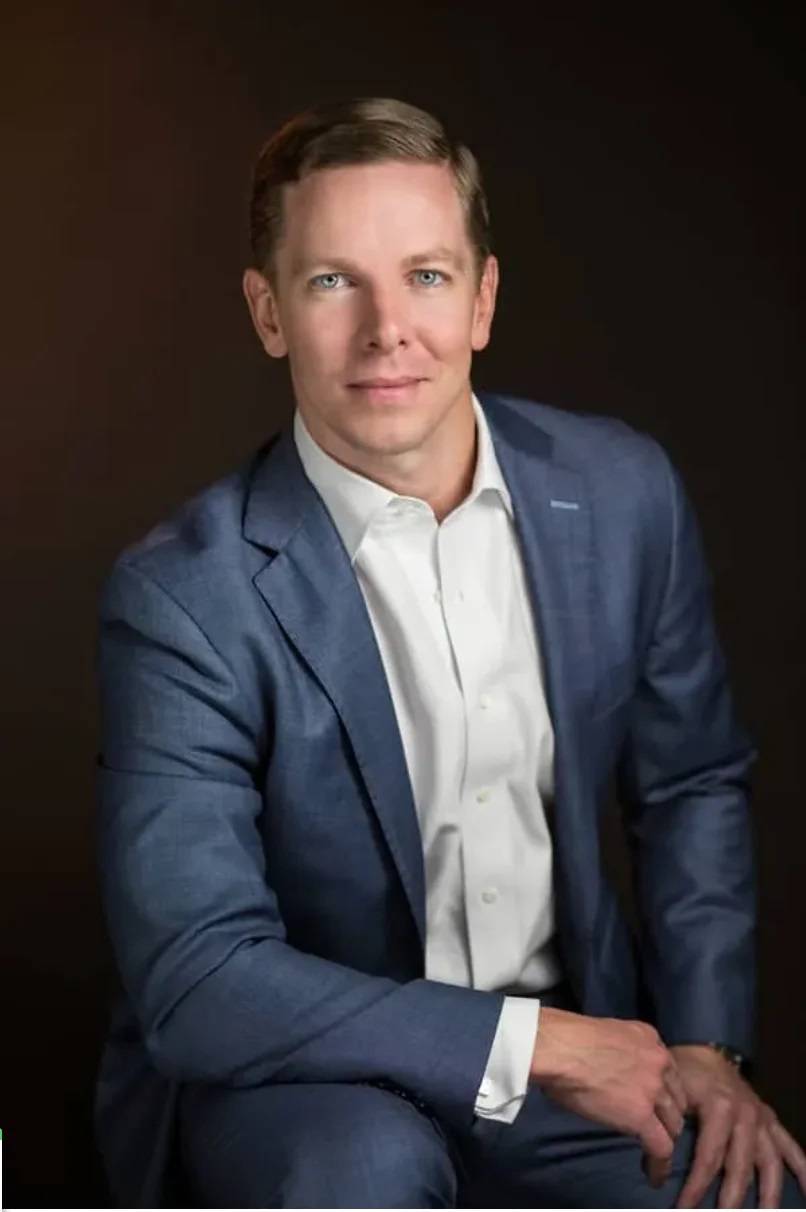
Dealing with the murky policies of insurance companies designed to confuse and prevent you from receiving compensation is our expertise.
15+ years experience as a personal injury attorney.
Specialized in battling insurance companies.
95% settlement rate for clients.
Handled 450+ personal injury cases.
Collected more than $50 million for clients.
450+ people have chosen Andrew as their attorney.
520+ Satisfied Clients
Our latest reviews on Google

Jennifer Cleveland
1 month ago
Lauren and her team are the best! Thank you for all the help, I 10/10 recommended them!

Ivanova Rodriguez
2 months ago
Great experience, kindness people

andrew rafidi
2 months ago
Project Backpack was a major success! Wonderful community outreach event! Emma Vinson is incredibly kind and helpful!

michele stanevich
2 months ago
What a wonderful event. Very well organized. He introduced himself to everyone. I will keep him in mind if and when I need a lawyer.

Lisa & Andrew Arnabat
2 months ago
Our team (attorney Tiffany Whitehouse, paralegals Vonda and Lindsey, our legal assistant Lauren, and Caroline) at Andrew Pickett Law has been absolutely amazing. They have been communicative from start to finish and have gone above and beyond in all aspects. They treated us like people, not like another number. Thank you for all of your help & guidance throughout what would have been an otherwise overwhelming and confusing process.

Thomas Preston
2 months ago
Andrew Pickett law for is a real good law and I will recommend him to need a real good lawyer.Thank you very much from my case.My name is Thomas Preston.Thank you

Close Family
3 months ago
Andrew Pickett and his team were very professional and supportave throughout my whole case. They took care of all the bills and successfully negotiated with the insurance companies. They were able to get 850,000 towards all the medical bills. I would definitelly recommend them.

Orestes Olmo
3 months ago
(Translated by Google) Excellent service. I was recommended by my daughter-in-law, and the beginning has been wonderful. They asked all the necessary questions and were incredibly quick at the start of the process. I am very grateful for their attention. (Original) Excelente trato ,fui recomendado por mi nuera y la verdad el inicio a sido maravilloso, hicieron las preguntas necesarias y una rapidez increíble en el comienzo del proceso , les agradezco mucho esta atención

Caitlin Cheatham
3 months ago
Amazing experience, they got me the best settlement I could’ve asked for. Always responded quickly and kept me in the loop! Highly recommend

Heidi Bushing
3 months ago
The team at Andrew Pickett is amazing. They helped me with two accidents and have been very attentive and communicative.

pebbs jai
3 months ago
I highly recommend this law office. Special thank you to Allison W. for answering all my questions and concerns. All staff were very helpful, professional and pleasant. They also give back to the community so if you are looking for a well knowledgeable law firm this is it!! Mr Andrew Pickett I appreciate you.

Krissy Green
3 months ago
Thank you all for your support I appreciate so much you guys are awesome

Stephanie Mortier
4 months ago
I absolutely love this law firm , down to the absolute best communication, and the follow up calls with details . Thank you guys !

Kimmy Ware-Simmons
4 months ago
A special thanks to this wonderful team! I’ve been truly blessed to be represented by Andrew Pickett Law. All my questions have been attentively addressed and explained perfectly in a way I am fully able to understand. This Lawfirm treats everyone with respect and like family. 10/10 review and definitely recommend!
Stephanie Mortier
4 months ago
Thank you , she was very helpful and friendly .

Steve Ryland
4 months ago
Andrew and his team provided outstanding legal representation with a high level of professionalism, responsiveness, and attention to detail. He communicated clearly throughout the process and delivered a result we were very satisfied with. I truly appreciate his expertise and would highly recommend him to anyone in need of strong, reliable legal counsel.

christian leon
4 months ago
Working with Tiffany Whitehouse, Vonda, and Lauren at Andrew Pickett Law Firm was an amazing experience for me. They were really professional, attentive, and committed to my case from beginning to end. Their diligence and genuine concern for achieving the greatest result for me were what truly stood out. I genuinely felt like I was in good hands the entire time because of their dedication and teamwork, which made a difficult situation much easier to face. I got the best outcomes I could have imagined because of their hard work and knowledge. I am incredibly appreciative and would heartily suggest their team to anyone in need of legal assistance.

Erin Mclachlan
4 months ago
My experience is based on 2 settlements so far, still pending another case and 1 of the already settled cases M&M took but didn't want to keep after stringing me along for 4 months. So just choose Andrew Pickett Law, don't waste time with another injury attorney. Tiffany Whitehouse is great, she was confident in my cases, kept me informed and very accommodating. We didn't even have to go to court for those 2 cases. And because I had already trusted them with 2 cases, I also gave them a third case which settled quickly. My only regret, I just wish I had known about them sooner. Thanks for everything! I have already recommended my friends and clients and will continue.

Carlos Mangual
4 months ago
Tiffany Whitehouse has been a tremendous help to me through out my whole process majorly because of her communication she’s always one phone call or text away and really gives me comfort to have any of my questions or worries answered so quickly

Hannah Dorris
4 months ago
If I could give more than 5 stars I would. I cannot say enough amazing things about Tiffany Whitehouse and her entire team. From the very beginning, I felt genuinely cared for, supported, and prioritized throughout my entire experience. Tiffany is an absolute powerhouse her knowledge, confidence, and attention to detail truly set her apart from any attorney I’ve ever worked with. She knows her craft inside and out, and you can feel that level of expertise in every interaction. What really stood out to me was how responsive and efficient everyone was. Communication was always clear and timely, and I was never left wondering about the status of my case. Tiffany and her paralegal, Vonda, worked seamlessly together and made everything feel organized and stress-free. Vonda was incredibly kind, attentive, and always made sure I had what I needed. They both went above and beyond in ways that made a stressful situation feel manageable. I also want to recognize the admin team, especially Lauren and Hailey. They were so welcoming, helpful, and professional every time I interacted with them. It’s clear that this entire office operates with a high level of care, compassion, and dedication to their clients. Another thing that truly stood out to me was how thorough and patient everyone was when answering my questions. No matter how many I had, they took the time to explain everything in detail and made sure I fully understood even if it took 20 minutes. That level of patience and dedication meant so much and made me feel confident every step of the way. What meant the most to me is that they didn’t treat me like just another case they truly cared about me as a person. They checked in regularly, made sure I felt supported, and consistently went the extra mile. That kind of genuine compassion is rare to find. If you’re looking for a legal team that is not only highly skilled but also truly invested in you, I wholeheartedly recommend Andrew Pickett Law. They exceeded all of my expectations and I am beyond grateful for everything they’ve done for me. Thank you all SO incredibly much!